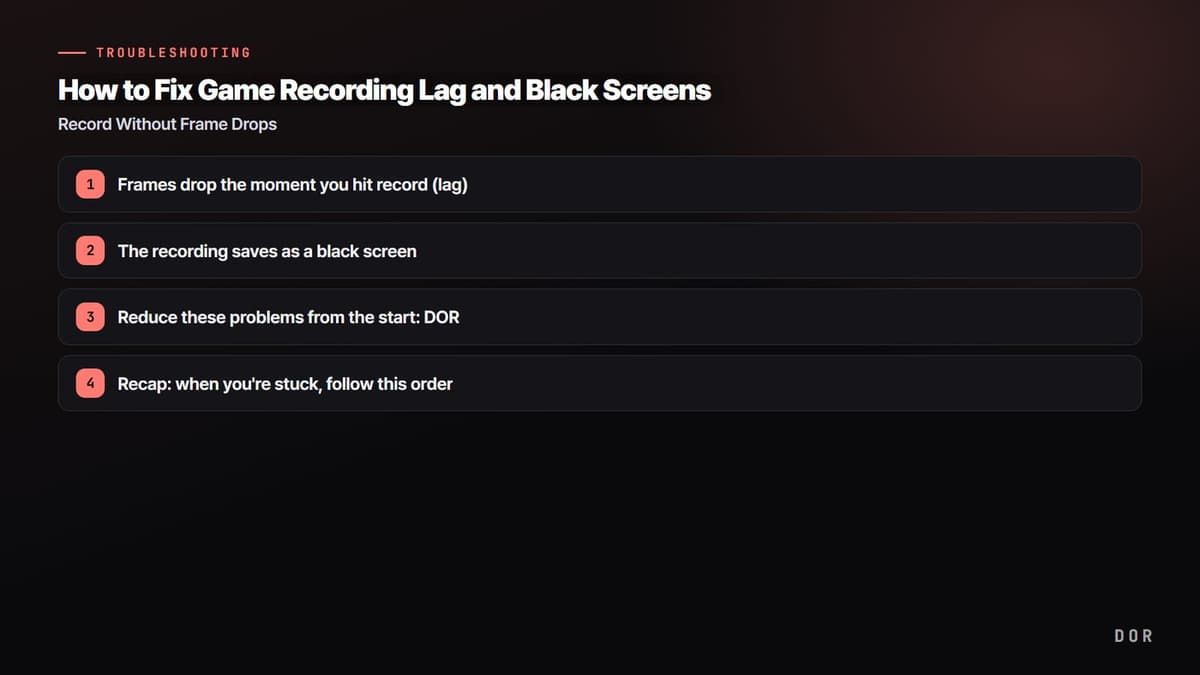
Two problems torment people more than anything else in game recording. First, the moment you hit record your frames tank (lag) and your actual gameplay falls apart. Second, the recording clearly went through but when you open the file the screen is pitch black with only sound. Both have fairly clear causes, and working through them in order solves most cases in 5 to 10 minutes. In this guide we'll use heavy games like Valorant, PUBG, and Battlefield 6 as our reference and walk through lag and black screens from cause to fix, step by step.
The short answer: lag is the encoder, a black screen is the capture method
For lag, start by switching the encoder to NVIDIA NVENC (AMF on AMD, QuickSync on Intel), and if it's still heavy, drop fps from 60 to 30 and then resolution from 1080p to 720p; most people are done at the first step. A black screen isn't a performance issue but a capture-method issue, so check just two things first: set the game to borderless windowed and run the recorder as administrator. If your goal is keeping your matches rather than tuning settings, leaving the free Windows app DOR running is the shorter route. It auto-detects supported games (see the game list), records full matches in the background with low-load NVENC hardware encoding, and saves them to its in-app library, so there's no encoder to pick and no record button to press.
To restate the big picture: lag is a question of "does the CPU or the GPU do the encoding," and a black screen is a question of "does the recorder have the right permission and method to capture the game screen." Just separating those two gets you halfway there.
Problem 1: frames drop the moment you hit record (lag)
The moment you start recording, a game that normally runs 144fps collapses to 90 to 100fps and your mouse feels sluggish. This is almost 100% encoding load. Where the work of compressing your screen into a video file (encoding) gets handled determines whether your game frames live or die.
Cause: software encoding (x264) eats your CPU
Many recorders default to "software encoding (x264)." This compresses the video using the CPU, and the problem is that the game uses the CPU too. With the game and encoding fighting over the same CPU, the higher you push quality, the more your game frames drop. Check your CPU usage and it often spikes to 80 to 100% the instant you start recording. In CPU-hungry large-scale battlefields like Battlefield 6, this is especially severe.
Fix: switch to hardware encoding (NVIDIA NVENC)
The key fix is changing the encoder to "NVIDIA NVENC." NVENC uses a dedicated encoding chip built separately into your graphics card (GPU) to compress the video. Because game rendering and encoding then use different resources, the load that was hitting the CPU nearly disappears. On the same PC, the heavy frame loss you get with x264 often shrinks noticeably after switching to NVENC. That said, if your GPU is already near 100% usage, NVENC will still cost you some frames, so at that point move on to the next steps (lowering fps and resolution).
- In OBS: go to Settings, Output, switch Output Mode to "Advanced," then under the Recording tab set the encoder to "NVIDIA NVENC H.264" (or HEVC).
- If you don't see an NVENC option: update your graphics driver to the latest in GeForce Experience or the NVIDIA app. An outdated driver can cause the NVENC option to not appear at all.
- On an AMD graphics card it's "AMD AMF/VCE," and on Intel integrated graphics it's "QuickSync," the hardware encoders that do the same job.
- DOR applies NVENC hardware encoding by default, so there's nothing for you to choose.
Set resolution, fps, and bitrate "not too high"
If it still stutters after switching encoders, your settings are too high. Cranking recording quality blindly raises encoding and disk load to match. Real-world sweet spots look like this. For a typical 1080p game, 1920x1080 resolution at 60fps with a bitrate around 20 to 30Mbps is plenty. If your goal is rewatching and saving highlights rather than uploading to YouTube, there's no need to push to 40 to 50Mbps. Cranking bitrate alone barely changes perceived quality while ballooning file size and disk write load, which causes stuttering.
On a low-spec laptop, start at 720p / 30fps
If you're on a gaming laptop or a PC with a somewhat weaker graphics card, we recommend dropping the ambition from the start and beginning at 1280x720 resolution and 30fps. 720p / 30fps has about a quarter of the encoding load of 1080p / 60fps, so your in-game frame loss is far smaller on the same PC. If the quality feels lacking, bump up to 1080p then. A lot of people start on max settings and end up assuming "recording is just supposed to lag."
Problem 2: the recording saves as a black screen
The recording clearly went through and the duration is normal, but when you open the file the whole screen is pitch black with only sound. The cause here is completely different from lag. It's not a performance issue, it's a permission and method problem where the recorder "couldn't capture" the game screen. Checking in the order below fixes most cases.
What Exclusive Fullscreen means: fullscreen vs borderless vs windowed
Exclusive Fullscreen is a display mode in which the game takes over the monitor's output. Because the game grabs the GPU output directly instead of going through the Windows desktop, recorders and overlays have a hard time getting into that frame, and per the OBS Game Capture Troubleshooting guide the game stops rendering altogether the moment you Alt+Tab out (verified 2026-09-15). Borderless Windowed is a window stretched to the size of the monitor, so it looks the same as fullscreen, but it's drawn on the desktop like any other window and recorders capture it normally. The same docs recommend Window Capture or windowed/borderless fullscreen for games that Game Capture can't pick up.
| Display mode | How it works | Recording capture | Notes |
|---|---|---|---|
| Exclusive Fullscreen | The game monopolizes the monitor output | Black screen if game capture is blocked | First thing to change if you get a black screen |
| Borderless Windowed | A window expanded to the monitor size | Captured normally like any window | Looks identical to fullscreen; the default recommendation for recording |
| Windowed | A regular window with a border | Captured normally, but only the window area | Uses only part of the screen, so it's less immersive |
First: change Exclusive Fullscreen to "Borderless Windowed"
This is the most common cause of a black screen. When the game's display mode is set to "Exclusive Fullscreen," the game monopolizes the GPU output path and the recorder can't slip into that screen, so the capture comes out black. The fix is simple. In the game's Settings, Graphics (Display), change the display mode to "Borderless Windowed (Borderless / Windowed Fullscreen)." As the table above shows, it's a windowed mode, so the recorder captures the screen normally. Valorant and PUBG both have this option in their graphics settings.
Second: run the recorder "as administrator"
If the game runs as administrator while the recorder runs with normal rights, the permission mismatch keeps the recorder from accessing the game screen, resulting in a black screen. This is especially common in anti-cheat games like Valorant and PUBG. Try launching the recorder's executable (.exe) by right-clicking and choosing "Run as administrator." If doing that every time is a hassle, you can right-click the executable, go to Properties, Compatibility tab, and check "Run this program as an administrator."
Third: update your graphics driver
If your driver is outdated, the screen capture API may not work properly, causing black screens or flickering. Update to the latest driver in GeForce Experience or the NVIDIA app for NVIDIA, or Adrenalin for AMD. It's a good idea to reboot your PC once after updating. Quite often a driver update alone fixes lag and black screens at the same time.
Fourth: on a laptop, assign the discrete (high-performance) GPU
Gaming laptops have both integrated graphics (Intel/AMD) and discrete graphics (NVIDIA), and if the game runs on the discrete GPU while the recorder gets assigned the integrated GPU, the two end up looking at different screens, producing a black screen. Go to Windows Settings, System, Display, Graphics (graphics settings), add the recorder, and set its option to "High performance (NVIDIA GPU)." The key is making the game and the recorder use the same GPU.
When you get sound but the screen is black
If the audio is fine and only the video is black, almost always the first (fullscreen to borderless) or second (admin rights) item above fixes it. The fact that sound was recorded means the recorder itself ran fine, and it's a signal that only the screen "capture path" was blocked. If your program uses game capture, switching to "display (monitor) capture" is also a quick workaround.
Reduce these problems from the start: DOR
If tuning all this by hand every time is a hassle, using something that lowers the setup burden is also an option. DOR is a free game recorder, and it's designed to take the lag half of this guide off your plate. First, NVENC hardware encoding is the default, so you record with little lag from the start without having to switch the encoder to NVENC yourself.
DOR also auto-detects supported games like Valorant, PUBG, and Battlefield 6 and records full matches in the background, and on games with auto clips such as Valorant and PUBG it also cuts key moments like kills and highlights into clips. Other supported games such as Battlefield 6 keep the full-match recording. The "I forgot to hit record and missed the play" problem goes away, and on auto-clip games the chore of "scrubbing through long originals to trim them yourself" shrinks too. Trim the scenes you want to keep in the browser clip editor and share them as a dor.gg link.
Recap: when you're stuck, follow this order
- For lag (frame drops): (1) switch encoder to NVENC, then (2) fps 60 to 30, then (3) resolution 1080p to 720p, then (4) bitrate inside 20Mbps.
- For a black screen: (1) fullscreen to borderless windowed, then (2) run as administrator, then (3) update graphics driver, then (4) (laptop) assign the discrete GPU.
- If you get sound but only the screen is black: check just (1) and (2) of the black-screen list first.
- If tuning every time is a hassle: start with DOR, which uses NVENC by default and records automatically.
Check the recommended recording settings on the page for the game you play most: Valorant, PUBG, Battlefield 6.