You've probably had the experience of uploading your first video and watching the view count stall in the double digits. That feeling that your play was clearly good but nobody's watching, almost everyone hits it when they first start a gaming channel. The good news is that there's a fairly fixed reason views stall at zero, and conversely, the way to grow them from zero is pretty clear too. This article lays out the realistic order of steps for lifting the views on your first gaming video and channel when you have zero subscribers.
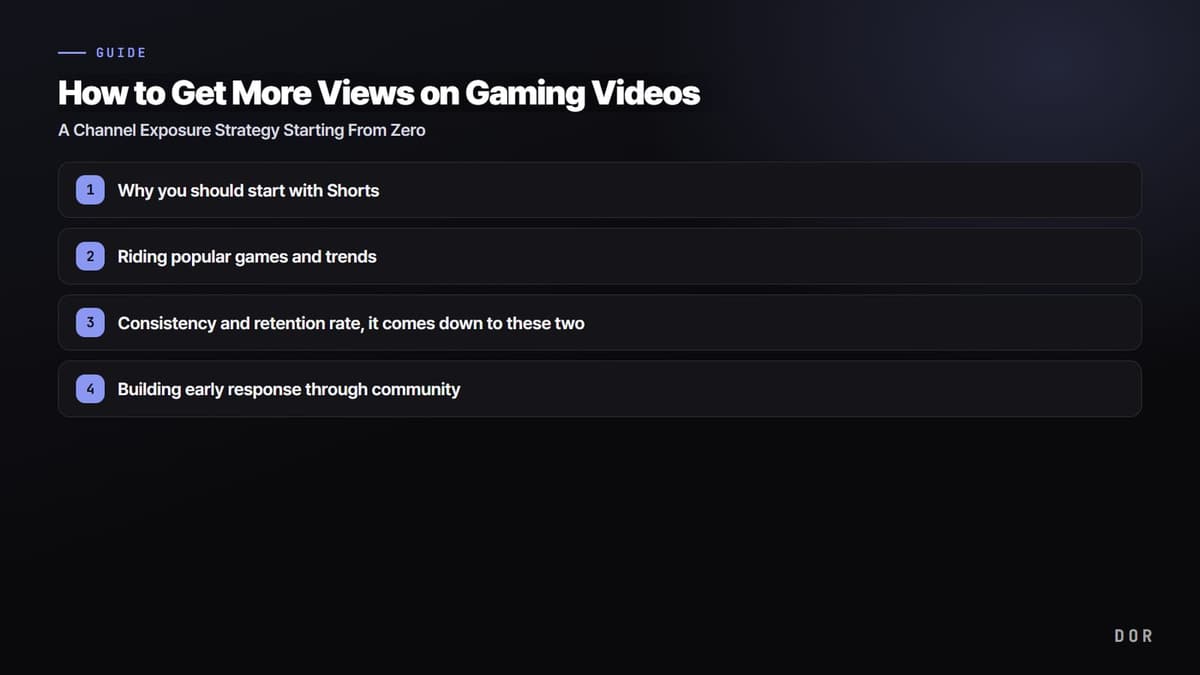
Here's the gist up front. Don't try to gather subscribers first; start with a format that gets exposure (Shorts), put real effort into your title, thumbnail, and first 3 seconds, ride popular games and trends, and upload consistently without stopping. We'll unpack each of these below.
Why you should start with Shorts
Long-form videos get recommended well once you've built up some channel trust and a subscriber base. Shorts, by contrast, are structured so that exposure is decided almost independently of subscriber count, based solely on a video's early response. In other words, Shorts is just about the only format where a single good video can rack up tens of thousands of views even at zero subscribers. For someone starting from zero, that's a huge advantage.
What does the Shorts algorithm look at?
Shorts get exposed to a small group first, then expand exposure based on the response. The signals it watches are the percentage who watch to the end (retention rate), the percentage who rewatch, and reactions like likes and comments. So the shorter the video, and the better it grabs attention early, the more it helps. Getting someone to watch a 30-second clip all the way through is rated far better by the algorithm than getting them to watch half of a 3-minute one.
Gaming content fits this format especially well. Self-contained 15-to-40-second highlights keep coming, like an ace round in VALORANT, a pentakill in League of Legends, or a 1v4 clutch in PUBG. You don't have to plan out a long video; a single match produces several Shorts ideas.
Views are won or lost in the title, thumbnail, and first 3 seconds
It's easy to think your gameplay skill decides your views, but what actually drives clicks and drop-off is the title, thumbnail, and opening. No matter how good a clip is, if it doesn't get clicked, exposure stalls, and even if it gets clicked, the algorithm stops pushing it if people leave in the first 3 seconds. Spending the most time here is the right call.
Title: search terms and curiosity together
Your title has to aim at two things at once. One is to capture search exposure by including the words people actually search (the game name, agent or champion names, the situation); the other is to make them click by not giving away the outcome. If the title reveals the whole result, there's no reason to click. Even for the same clip, a single line in the title can mean a several-fold difference in click-through rate.
Thumbnail: readable within 1 second
For Shorts, the first frame and the title matter more than the thumbnail, but in long-form and on the Explore tab, the thumbnail decides the click. It has to be readable within 1 second even on a small screen what's going on. Keep text large and short, include an at-a-glance element like a facial expression or a kill count, and if the background is busy, blur it boldly.
First 3 seconds: show the conclusion up front
If you lay out a long situation explanation in the opening, people leave before it pays off. Hook them in the first 3 seconds by flashing a 0.5-second preview of the highlight's climax up front, or by starting right before the most shocking moment. In Shorts, these first 3 seconds all but decide your retention rate.
Riding popular games and trends
For the same effort, creating where demand is concentrated is overwhelmingly more favorable. Pick a popular game that many people search and that has a large recommendation pool, and within it, target the moments when trends are moving. When a new patch, a new agent or champion, a new map, or a major balance change drops, search volume for those keywords temporarily explodes.
- New agent or champion release: posting gameplay and tips videos timed to launch day lets you claim search demand first.
- New map or mode: it's the moment people are curious how others are playing, so beginner and strategy clips land well.
- Right after a major patch: the meta shifts, so "what should I use now" searches surge.
- Tournament and event season: content that imitates or analyzes plays that became talking points gets recommended.
The way to catch trends is simple. Subscribe to the official patch notes and developer announcements for the game you play, and check briefly every day what the community is buzzing about. If you jump in after everyone else has already made their videos, you're already late. You have to start preparing material the moment a patch is teased to make it in time for launch.
Consistency and retention rate, it comes down to these two
The difference between a channel that pops once or twice then vanishes and one that grows slowly is almost entirely consistency. The algorithm trusts channels that put out content on a regular cadence, and the more videos pile up, the higher the chance that one of them takes off. In the beginning, the goal itself should be to not stop uploading, more than the view count.
Why most people stop here
The most common reason consistency breaks is, surprisingly, running out of material. You keep forgetting to hit record when you mean to capture a highlight, and the good plays always happen when you didn't hit record. Hunting through long footage for the usable section and cutting it is a burden too, so after doing it a few times, the upload cadence collapses.
Editing that raises retention rate
Even the same clip gets better retention when you trim the dead weight. Cut out the loading and travel sections, add short captions to set up the situation, and start right before the climax. When the intro, climax, and wrap-up flow as one breath within 30 seconds, people watch to the end. The moment you artificially stretch it to pad the length, retention drops.
Building early response through community
The algorithm watches the early response and then expands exposure. So those first few dozen views and comments matter, and when you have no subscribers, the community is what creates them. Sharing your video in the Discord, group chats, and related communities for the game you play generates early views and reactions, and that becomes a good signal to the algorithm.
That said, spamming bare links backfires. Take part in conversations in that community regularly, and share your video in a context that becomes a conversation, like "how should I have played this situation?" 100 early viewers who genuinely watch to the end help your channel grow more than 1,000 impressions scattered with no context.
Three common misconceptions
- The misconception that you have to gather subscribers first: the order is backward. When a good video gets exposure, subscribers follow as a result. Shorts get exposure even with no subscribers.
- The misconception that you have to gear up with equipment and material first: rather than high-end gear or an elaborate plan, cutting and posting one highlight you already have well comes first.
- The misconception that you just have to upload a lot: volume matters, but if you only increase volume without a title, opening, or retention, the algorithm won't push it. The answer is consistency with analysis.
Automatic clips that eliminate material shortages
Even if you know every strategy above, when you have no material in hand, uploads grind to a halt. DOR solves this exact point with automation. Once installed, it automatically detects when a game launches, records in the background, and cuts key moments like a VALORANT ace, a League of Legends pentakill, or a PUBG clutch into short clips and saves them on its own. There's no record button to press and no long source footage to scrub through hunting for the right section.
As a result, by the time you close the game, that day's Shorts candidates are already stacked up in your folder. The biggest cause of failure, running out of material because you missed a highlight, disappears, so all that's left is to polish the title and first 3 seconds and upload consistently. It's free and watermark-free, so there's no burden for someone starting their first channel.