A lot of people start uploading videos because they love gaming, then get stuck on one question: "What exactly do I need to hit before this actually makes money?" YouTube monetization isn't a single button. It's a structure where you first meet certain requirements to join the YouTube Partner Program (YPP), and then revenue sources like ads, fan funding, and sponsorships open up one after another. This article walks through the joining requirements, the revenue sources, and the most common stumbling block of all, copyright, in order, with gaming channels in mind.
First, one thing to make clear. The numbers below for subscriber count, watch time, and views can change at any time under YouTube's policies. Before you actually apply, always check the latest requirements that apply to your channel directly in the "Monetization" tab of YouTube Studio. The numbers in this article are rough guidance values as of 2026.
The YouTube Partner Program (YPP) is the gateway to monetization
To earn ad revenue on YouTube, you first have to join the YPP. Joining YPP is what lets you run ads before, during, and after your videos and turn on Shorts ad revenue sharing, channel memberships, and Super Chat. In other words, it's not "views equal money" so much as "join YPP, then activate revenue features, and from that point on views turn into money."
There are two main paths into YPP: the standard track centered on long-form videos, and the Shorts track centered on short vertical videos. Meeting either one makes you eligible to apply, and both require a subscriber threshold plus passing review as a "clean channel with no inappropriate content."
Standard track: roughly 1,000 subscribers + 4,000 watch hours
This is the most traditional path. You can usually apply once you hit roughly 1,000 subscribers along with 4,000 cumulative watch hours over the past 12 months. "Watch hours" here means total time watched, not view count, so a 15-to-20-minute full match or guide video racks up watch hours faster than a 5-minute clip. That's exactly why longer content like a full match of League of Legends or a single PUBG squad game works in your favor on this track.
Shorts track: roughly 1,000 subscribers + 10 million views in 90 days
This is the path for channels that compete with short videos. You can usually apply once you hit roughly 1,000 subscribers along with 10 million total Shorts views over the past 90 days. 4,000 watch hours is honestly a pretty high wall, so gaming channels often aim for the Shorts track to grab "monetization eligibility" quickly. That said, 10 million views is no small number either, so a more realistic strategy is to consistently post highlight Shorts and reach it cumulatively, rather than betting on one or two viral hits.
Some fan-funding features unlock first at a lower threshold
Even before you've met the full requirements for ad monetization, fan-funding features like Super Chat, Super Thanks, and channel memberships sometimes unlock first at a lower subscriber threshold. In other words, even an early-stage channel that hasn't hit the full 4,000 ad watch hours may have room to start earning through direct support from fans. These thresholds also vary by policy, so the most accurate approach is to check which features show as "available" in your channel's Monetization tab.
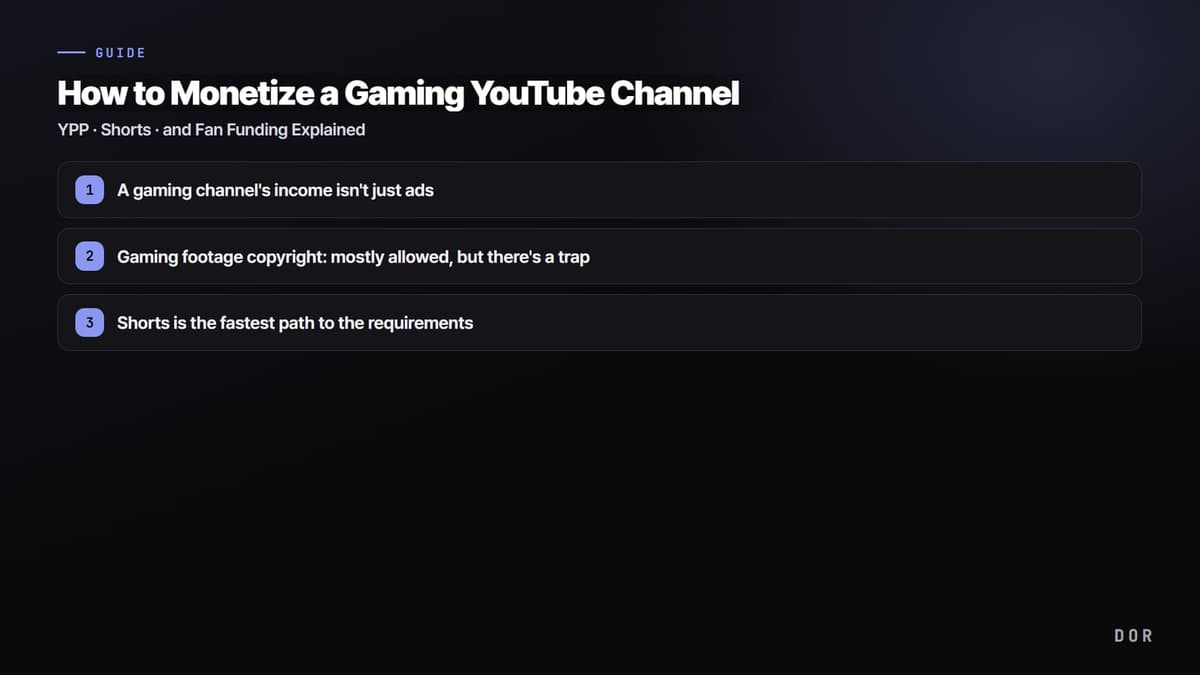
A gaming channel's income isn't just ads
Once you're in YPP, revenue comes in from several directions. Rather than leaning on just one, stacking multiple revenue sources is what keeps things stable.
- Ad revenue: in-stream ads on long-form videos. It depends on view count and ad rate (CPM), and rates vary widely across gaming genres depending on the audience.
- Shorts revenue sharing (the Shorts pool): ad revenue from Shorts is split among creators by their share of views. This fits gaming channels that post large volumes of short highlight clips well.
- Channel memberships: recurring revenue from members who pay a monthly fee in exchange for exclusive badges, emoji, and members-only videos. Powerful for channels with a loyal fan base.
- Super Chat and Super Thanks: amounts viewers tip directly during live streams or on videos. A great match for live gaming streams.
- Sponsorships and brand deals: paid collaborations with gaming gear, new game titles, and peripheral brands. Once your subscriber base reaches a certain size, this can become your highest-paying revenue source.
Early on, ads and the Shorts pool bring in small amounts; as your fan base solidifies, memberships and Super Chat grow larger; and as your channel gets bigger, sponsorships join in, shifting where the center of gravity sits. That's why, over the long run, the bigger variable isn't "the ad rate right now" but consistently uploading to build subscribers and a steady audience.
Gaming footage copyright: mostly allowed, but there's a trap
"Is it okay to upload gameplay footage and make money from it without copyright issues?" is the most common question. The short answer: most major game studios officially allow individual creators to upload and monetize gameplay footage. Popular titles like VALORANT and League of Legends maintain streaming and video guidelines and keep things open to the point of practically encouraging it. Recording and uploading the game screen itself generally isn't blocked.
The real trap hides not in the game screen but in the "sound" and the "video clips." Licensed in-game BGM, intro cinematics, and cutscenes may carry the rights of a third party (a music label or video company) rather than the game studio, so if a copyright claim (Content ID) lands on those parts, that video's revenue can be redirected to the rights holder or ads can be blocked. This is where that somewhat unfair situation comes from: the game is allowed, but a copyright claim hits because of the music inside it.
Shorts is the fastest path to the requirements
4,000 watch hours is the biggest wall for a new channel. Shorts, by contrast, get exposed quickly by the algorithm, and when one takes off, views can explode, making the 90-day 10-million-view path genuinely realistic. So a sensible early strategy for a gaming channel is to gather subscribers and views with highlight Shorts first, then bring those fans over to your long-form videos.
The catch is that Shorts need "raw material" too. To post daily, you need a good moment every day, but the amazing kill or the comeback teamfight tends to happen exactly when you didn't hit record. Manually recording and editing every PUBG chicken dinner moment or VALORANT ace into a Short is more labor than it sounds, and when that labor becomes too much and the uploads stop, that's the single most common reason channels die.
Consistency is the key, and you protect that consistency with automation
The real variable in monetization isn't a one-off viral hit but "uploads that never stop." DOR automatically detects when a game launches and records in the background, then cuts key moments like kills, aces, pentakills, and chicken dinners into short clips on its own. There's no record button to press and no long footage to scrub through hunting for the right section, so by the time you close the game, your best moments are already stacked up and ready to post as Shorts. It's free and watermark-free, so you can upload as-is.
To sum it up, the flow looks like this. Play your games as usual while DOR automatically collects your best moments, post those clips consistently as Shorts to hit roughly 1,000 subscribers and the view requirement, join YPP, and then broaden your revenue across ads, the Shorts pool, memberships, fan funding, and sponsorships. Check out auto-clip examples and recommended settings on the page for the game you play most: VALORANT, League of Legends, PUBG.