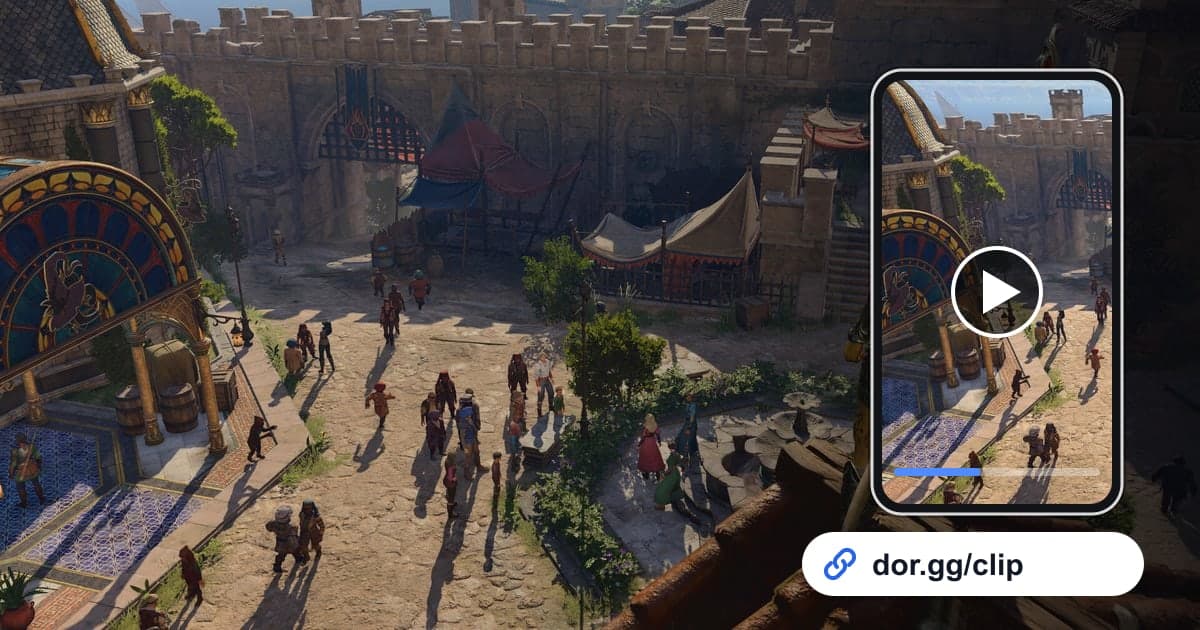
The moments you most want to talk about in Baldur's Gate 3 usually come down to one roll of the dice. A persuasion check with poor odds that came up a natural 20, a turn where you spread grease, set it alight, and cleared a group of enemies at once, or a conversation where a companion shook their head at your choice. This guide covers one method only: record Baldur's Gate 3 with DOR, find that scene in a session that runs for hours, trim it, and send it as a dor.gg link. It also covers how the audience and the cut change between a solo campaign and online co-op with up to four players.
Turn-based play makes long recordings; you send one roll or one turn
DOR saves Baldur's Gate 3 as a whole-session recording. After you load your save, exploring the map, haggling with traders, talking to companions at camp, and turn-based fights that can take tens of minutes once they start all go into a single video. DOR does not detect dice results or kills to make separate clips, so you find the scene you want in the recording and pull it out with trimming. Many evenings in this game go to exploring a single area, so it helps to review recording long gameplay without stutter first to keep long recordings stable to the end. Also keep in mind that recording stops automatically when free space drops below 20GB.
From choosing one roll to sending it to your party
- 1Decide your audience by solo or party playFor a solo campaign, think of friends who have not reached the same point yet and pick a fight or a dice scene with few spoilers. For online co-op, the party members from that session come first. DOR records the game running on your own PC, so a party member's point of view only exists if they record it on their PC.
- 2Load your save with DOR runningDOR is a free Windows app, and when you launch Baldur's Gate 3 it detects the game and starts recording automatically. If you want to keep your own voice from a co-op session too, connect a microphone. Game sound and microphone are recorded together in one video.
- 3Use the dice roll window as your first clueWhen a conversation calls for a check like persuasion or deception, a dice roll window appears in the middle of the screen. Because it changes the whole look of the screen, it stands out even when you scrub quickly through the recording in the library. Start from the line a few seconds before the window so viewers know why you rolled.
- 4Find fights by the moment the turn order appearsWhen combat starts, the turn order for your party and the enemies appears at the top of the screen. Even if a fight drags on, what you want to show is often the one turn of yours that changed it, so glance at the clock on your phone when that turn begins and it will be easy to find later.
- 5Trim from just before the roll to the reactionIn the app library's trim tool, set a start and an end. For a dice scene, run from just before the roll window appears to the other character's reaction after the result. For a fight, run from the start of your turn to the end of your last action. Pick 16:9, 9:16, or 1:1, and when trimming finishes a dor.gg link is created.
- 6Send the link with the check and the odds in one linePut one line in front of the link saying which check it was and whether it looked hard to pass, and the viewer will be on edge before the result appears. For a scene where the story splits, name the area of the conversation and leave out the outcome.
Clues and audiences by type of scene
| Type of scene | Clue in the recording | Good person to send it to |
|---|---|---|
| Natural 20 on a dialogue check | The moment the dice roll window appears in the middle of the screen | Anyone; the result alone is fun |
| Critical failure | The reaction right after a 1 shows up in that same window | A friend who will laugh with you |
| One-turn combo | The point where combat starts and the turn order appears at the top | A friend who plays the same class |
| Terrain combo | A spell cast right after grease or water spreads across the ground | A friend who loves tactics |
| Companion reaction | A companion speaking up right after you pick a dialogue option | A friend who has finished the game |
| Co-op party chaos | Party members splitting up and opening different conversations | The party members who were in that session |
Before you send a BG3 clip
- My dice clip starts from the dialogue before the roll window appears.
- My fight clip keeps only the one turn that changed things and cuts the rest.
- I sent the co-op clip to the party members who were there first.
- I checked my friend's progress before sending a companion or romance scene.
- I had well over 20GB of free drive space before a long exploring session.
- I opened the link once to check that dialogue and sound effects come through.
How DOR captures Baldur's Gate 3
DOR is a free Windows desktop app. Since an app update in October 2026, Baldur's Gate 3 is a supported game: launch it and DOR detects it automatically and records the entire session as a single mp4 until you quit. Because the game is not split into matches, there are no automatic highlights, and you can turn full-session recording on or off per game in the settings. On a PC with an NVIDIA graphics card, NVENC hardware encoding is the default. If you want to gather several dice scenes from one area into a single video, merging game clips explains how to settle the order. Merging and adding text happen in DOR Studio, covered in the browser clip editor article, with no install. You can share the finished video as a dor.gg link or download it as an mp4, and party members who get the link watch it in a browser without the app.