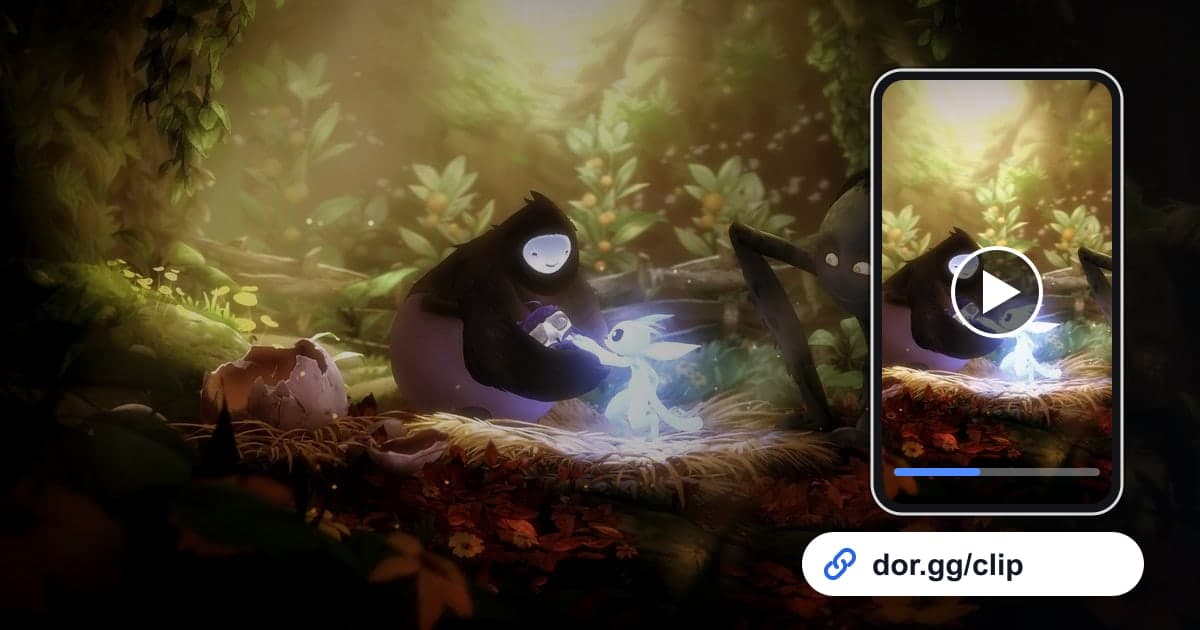
Ori and the Will of the Wisps is an action platformer where the little spirit Ori travels through a forest that looks hand-painted. Plenty of moments are hard to clear on the first try, like stretches where you have to chain wall jumps and dashes without a break, or sequences where you flee from a towering enemy, so when you finally make it through you want to show someone. On the other hand, footage of falling in the same spot dozens of times can be just as entertaining for friends. This guide shows how to record your play with DOR, pick the one attempt worth showing, and send it as a dor.gg link. Ori and the Will of the Wisps became a DOR supported game in an app update in October 2026.
Deciding which of your many attempts to send
DOR records Ori and the Will of the Wisps as a whole-session recording. From launch to exit, exploring, failing, retrying, and succeeding all continue as one video, and DOR does not detect defeated bosses or cleared sections to create clips automatically. So where you trim depends on what you want to show. Decide first whether to show one clean success, add the painful near miss right before it for drama, or collect only the failures for laughs. If you want to capture your groans and cheers along the way, balance your audio first with how to record game sound and mic together.
Steps to pick and send an Ori highlight
- 1Leave DOR running and play as usualDOR is a free Windows app. When you launch Ori and the Will of the Wisps, it detects the game automatically and starts recording. However many times you retry, it continues as one video until you close the game, so there is nothing to set up before a hard section.
- 2Note the time when you enter a hard sectionExploration takes time, so recordings easily run for hours. Jot the real-world time on your phone when you reach a boss or a chase sequence, and comparing it with when recording started tells you roughly where the attempts are in the video.
- 3Count the restarts to separate attemptsScrubbing through the recording in the library, every failure is followed by a screen change and Ori setting off again from the same spot. Count those restarts to tell attempts apart. What comes after the last restart is the successful run.
- 4Trim to match how you want to show itFor a success only, trim from the moment you enter the section to just after you clear it. For drama, trim from the last failure through the success in one go. For a failure reel, cut each failure to a few seconds and merge them into one video later.
- 5Keep the painterly visuals in 16:9The game's appeal lies in its backgrounds and wide compositions, so 16:9 fits best. For scenes focused on Ori's movement alone, like a short wall jump chain, 1:1 also works well for phones.
- 6Ask how far your friend has played, then sendWhen trimming finishes, you get a dor.gg link. If the scene reveals a boss or story, ask your friend how far they have played first, and send friends who have not finished a platforming section with fewer spoilers. They watch it in a browser with nothing to install.
Which attempt to pick for each scene, and how spoiler-heavy it is
| Scene | Attempt to pick | Spoiler risk |
|---|---|---|
| Fight with a towering enemy | The successful attempt plus the failure right before it | High, the enemy is revealed |
| Chase and escape sequence | The attempt you cleared by the narrowest margin | Medium, it hints at where the sequence is |
| Wall jump and dash chain | The cleanest attempt with no mistakes | Low |
| Failure reel | Several falls in the same spot strung together | Low |
| First view of a new area | The moment the area first opens up, whatever the attempt | Medium, the area's look is revealed |
| Story scene | The scene as you saw it the first time | Very high, only for friends who finished |
Before you send an Ori clip
- You decided whether it is a success, a success with a near miss, or a failure reel.
- A success clip starts the moment you enter the section.
- You checked whether your friend has already seen this boss or story scene.
- Long stretches with the menu or map open have been cut.
- After hours of play, your recording drive still has well over 20GB free.
- If your voice is in the clip, you checked that it is fine for others to hear.
How DOR records Ori and the Will of the Wisps
DOR is a free Windows desktop app. When you launch Ori and the Will of the Wisps, it detects the game automatically and saves the whole session until you exit as a single mp4. Game sound and your mic are recorded together, and on PCs with an NVIDIA graphics card, NVENC hardware encoding is used by default. There are no automatic highlights, so set the start and end with the library's trim tool, choose 16:9, 9:16, or 1:1, and send a dor.gg link that plays in a browser without the app. To turn your failures into one video, use the DOR browser editor, which needs no install, to merge videos, add text and effect templates, then download an mp4 or share a link. For tips on choosing an eye-catching cover shot for the finished video, see how to make a game clip thumbnail. Long exploration fills your drive quickly, and recording stops automatically once free space drops below 20GB.