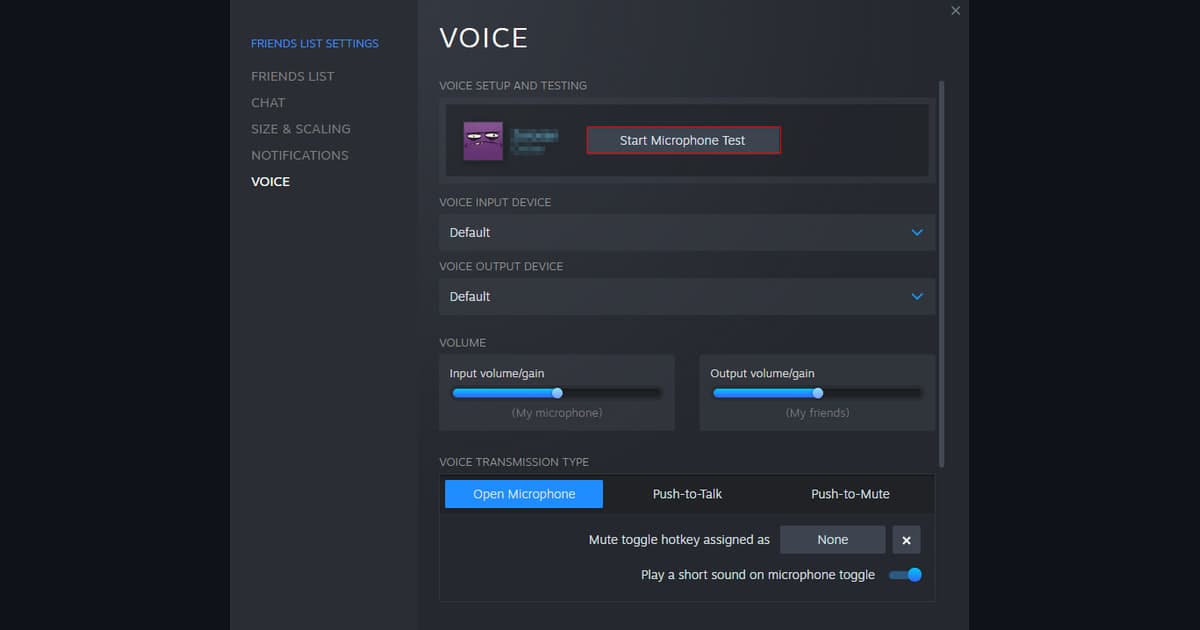
Steam recording is not picking up your mic: the clip has game sound but no microphone, or launching the game switches the input to another device. Because game audio is already present, keep that working path and test only the microphone, in this order. First, open Windows Settings > Privacy & security > Microphone and confirm that Microphone access, Let apps access your microphone, and Let desktop apps access your microphone are all on; Steam is a desktop app, so the last toggle is the one that silently blocks recordings. Second, under System > Sound > Input, make the headset the default device and watch its meter while you count aloud. Third, in Steam open Friends & Chat, the gear icon, then Voice, run Start Microphone Test, and make sure the same device is selected, because Steam says a mic that works in the test but not in-game was probably switched to another input at launch. Fourth, turn the microphone option on in Steam > Settings > Game Recording and save a thirty-second clip of the same count. A dead meter points outside Steam; a moving meter with a silent clip narrows it to the Steam recording option or app permission. A reconnected USB headset can come back under a new device name, so reselect it instead of trusting the old default, and if Windows sound enhancements such as Voice Clarity are on for that microphone, turning them off is a reversible check that users report fixing silent clips. If the game sound is missing too, use the Steam recording no game sound guide instead. Diagnose a mic that is not picked up in Steam Game Recording by separating detection, permissions, hotkeys, storage, capture, and audio playback.
Map each symptom to a small verification test
| Observed symptom | Likely stage | Smallest useful test |
|---|---|---|
| Steam recording is not picking up your mic: the clip has game sound but no microphone, or launching the game switches the input to another device. | Steam clips stop recording the microphone when one gate is closed: the microphone option in Steam > Settings > Game Recording, Windows microphone privacy for desktop apps, the Windows default input device, the device selected in Steam Voice, or a USB headset that reconnected under a new name. | Allow desktop apps to use the microphone in Windows privacy settings, set the correct default input, turn the microphone option on in Steam > Settings > Game Recording, then save a thirty-second clip while counting aloud. |
| Hotkey reacts but no save confirmation appears | Another overlay owns the shortcut or the replay buffer is inactive | Assign a conflict-free key and create a thirty-second sample |
| Confirmation appears but the file seems missing | Save path changed, storage is low, or retention removed it | Open the configured media folder and check free space |
| A file exists but video or sound is wrong | Capture mode, device route, codec, or playback track | Play the short original in a second normal media player |
Separate the failed stage from the result you want
Steam clips stop recording the microphone when one gate is closed: the microphone option in Steam > Settings > Game Recording, Windows microphone privacy for desktop apps, the Windows default input device, the device selected in Steam Voice, or a USB headset that reconnected under a new name. The first controlled check is therefore: Allow desktop apps to use the microphone in Windows privacy settings, set the correct default input, turn the microphone option on in Steam > Settings > Game Recording, then save a thirty-second clip while counting aloud. The relevant path is Steam > Settings > Game Recording (audio options), Windows Settings > Privacy & security > Microphone, and Windows Settings > System > Sound > Input; if that menu is absent, confirm the installed version and eligibility before copying older instructions. Allow desktop apps to use the microphone in Windows privacy settings, set the correct default input, turn the microphone option on in Steam > Settings > Game Recording, then save a thirty-second clip while counting aloud.
A controlled troubleshooting sequence
- 1Confirm eligibility and mode — Open Steam > Settings > Game Recording (audio options), Windows Settings > Privacy & security > Microphone, and Windows Settings > System > Sound > Input, verify the feature is enabled, and confirm the current game and display mode are supported.
- 2Restart at one permission level — Exit both the game and recorder, close competing capture tools, then relaunch them with matching privilege levels.
- 3Create a thirty-second control sample — Allow desktop apps to use the microphone in Windows privacy settings, set the correct default input, turn the microphone option on in Steam > Settings > Game Recording, then save a thirty-second clip while counting aloud.
- 4Separate saving from playback — Confirm the notification and actual file first, then inspect video, game audio, voice chat, and microphone independently.
- 5Escalate with evidence — If it still fails, record versions, GPU, settings screenshots, a short reproduction sequence, and the sample file details.
Final checklist before a real match
- The game and recorder are not running at mismatched administrator levels
- The required recording or replay buffer is active in this session
- The hotkey does not overlap the game, chat, or another overlay
- The media folder is writable and has sufficient free space
- A thirty-second file with separately verified game and microphone audio plays normally
Use DOR for a future supported-game session
Fix a mic that is not picked up in Steam Game Recording: a safe troubleshooting order: For a separate DOR test in a future supported-game session, use the free game recorder comparison, game-audio troubleshooting guide, and VALORANT game hub. DOR takes the opposite approach for supported games: when it detects the game and starts recording automatically, it captures game sound and your microphone together by default, so a mic that was never switched on in the recorder is not a failure mode there; see how DOR records game sound and mic together and a supported-game example in PUBG highlights.
Recheck the current official documentation
The Steam Game Recording FAQ says the settings let you choose what audio is captured, including audio from other programs such as voice chat, and the Steam microphone troubleshooting page says a mic that passes the test but fails in-game was probably switched to another input when the game launched, so check the device in the operating system, in Steam, and in the game. Steam Game Recording support.