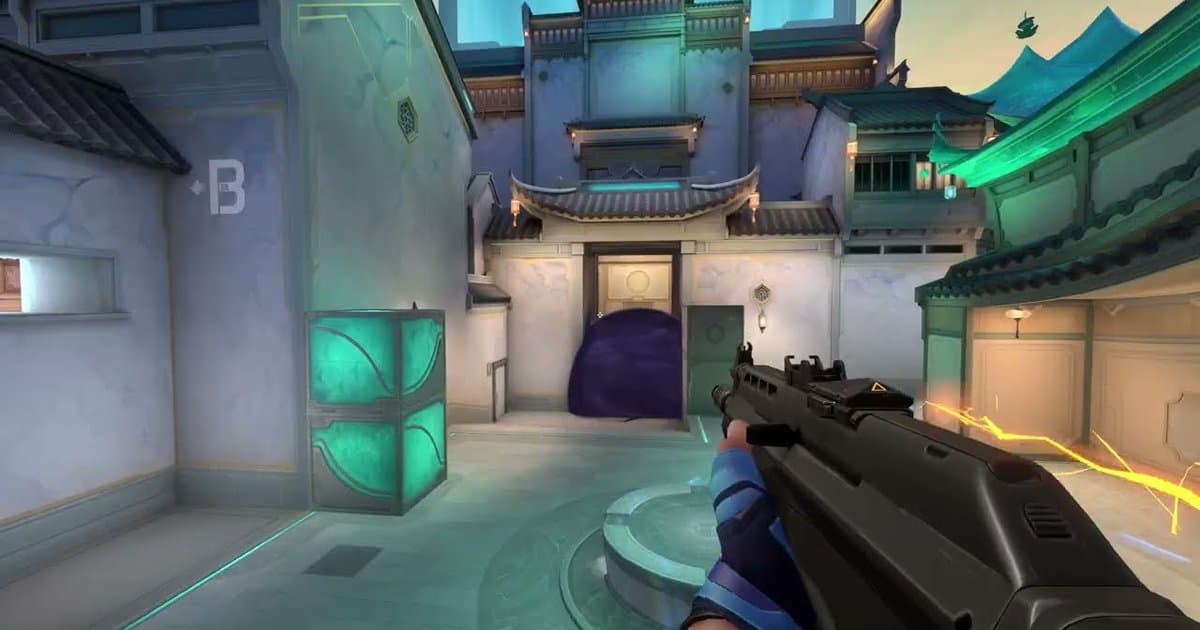
Search for valorant stretched res and two questions come up together: which resolution should you run on your monitor, and how do you get the 4:3 stretched look many players know from CS into VALORANT. Stretched res means the game renders at a 4:3 resolution and that image is stretched across the full width of a 16:9 monitor. Fill a 1920×1080 screen with 1440×1080 and the whole image is stretched about 1.33 times horizontally, so your crosshair and HUD look broader. In CS, player models look wider too; whether VALORANT's agents widen the same way is something community guides disagree on, so the last step below shows how to check it yourself. Leave it unstretched and you get black bars on both sides, usually called letterboxing. Riot does not publish an official guide to stretched res. Riot's support article Supported Resolutions in VALORANT (posted May 14, 2026) lists 4:3, 5:4, 16:9, 16:10 and 21:9 resolutions, highly recommends 16:9, and explains that if you play at an unsupported resolution, black bars crop your screen to a supported one. So this guide sticks to resolutions on Riot's list and only uses the game menu plus the official NVIDIA and AMD driver settings. It does not cover editing config files or third-party tools. One more thing changed recently. Patch 11.02 on July 29, 2025 moved VALORANT from Unreal Engine 4.27 to Unreal Engine 5.3. Riot said the switch has no direct effect on how you experience the game apart from small performance improvements, but community creators soon published separate post-update stretched guides (August 2025), so guides written before July 2025 may not match the current client. If you followed an older guide and the screen never stretched, work through the steps below. Game and driver menu names were checked on October 16, 2026 and can differ slightly by version and language.
Bottom line: start at your native 16:9 resolution, and choose 4:3 only after comparing recorded matches
There is no resolution that is right for everyone. On ProSettings.net, which collects published pro settings (updated May 18, 2026, based on 700 pros), 68% of pros use 1920×1080 and the other 32% use something else. The site notes that some pros play stretched but says it does not give any real advantage in VALORANT, and Riot itself highly recommends 16:9. If you are new to this, your monitor's native resolution is the safe default. Players still pick 4:3 stretched for three common reasons. First, the hope that agents will look wider and easier to spot, the way player models do in CS. Community explanations differ on whether VALORANT's agents actually widen that much (some say only the crosshair and HUD stretch), and even if they look wider, their size in the game and the area that counts as a hit stay the same. Second, a lower resolution means fewer pixels to render: 1440×1080 draws 75% of the pixels of 1920×1080, and 1280×960 about 59%. On a PC where the graphics card holds back your frame rate, that can raise FPS; on a PC that hits a CPU limit first, the gain may be small. Third, muscle memory from playing 4:3 in CS or other shooters. There are costs too. A stretched lower resolution looks a little softer, and horizontal movement can feel faster because the picture is wider. Whether 4:3 also shows less of the sides than 16:9 is something community sources describe differently, and we found no official Riot explanation. That is why it is better to decide by comparison than by feel. Record a few matches at 16:9 and a few at 4:3 stretched in the same mode, then watch the fights side by side: whether you spotted the enemy first and whether your aim kept up on wide swings is all there in the footage. DOR detects VALORANT automatically when you launch it, records your matches and saves kill and death moments as separate clips, so collecting before-and-after fights to compare needs no extra setup.
How to set up Valorant 4:3 stretched res on NVIDIA and AMD
- 1Pick a 4:3 resolution from Riot's supported listRiot's 4:3 list is 640×480, 800×600, 960×720, 1024×768, 1280×960, 1400×1050, 1440×1080, 1600×1200, 1856×1392, 1920×1440 and 2048×1536. On a 1920×1080 monitor, choose 1440×1080 or 1280×960; on a 2560×1440 monitor, choose 1920×1440 or 1440×1080. Riot says its list is not complete but also says unsupported resolutions get cropped with black bars, so a value outside the list may never stretch.
- 2NVIDIA: create a custom resolution in the Control PanelIf the resolution you picked already appears in the resolution list in Windows display settings, skip this step. If not, open the NVIDIA Control Panel, go to Display > Change resolution, select your monitor, then click Customize > Create Custom Resolution. Enter the width and height you want, such as 1440 and 1080, set the refresh rate to the one you normally use (for example 144 Hz or 240 Hz), click Test, and save it if the test passes.
- 3NVIDIA: set scaling to Full-screen and perform scaling on the GPUIn the same Control Panel, open Display > Adjust desktop size and position > Scaling and choose Full-screen. Aspect ratio keeps the original proportions and can leave black borders, and No scaling shows the image at its original size in the middle of the screen. Set Perform scaling on to GPU so the graphics card, not the monitor, does the stretching. NVIDIA's help describes that option as one for advanced users, but it is the first place to look when black bars stay.
- 4AMD: custom resolution and GPU Scaling set to Full panelIn AMD Software: Adrenalin Edition, type Custom into the search box and open Custom Resolution. On first use, accept the license agreement, then click Create New, enter your resolution and click Create. Next, type Display into the search box, open Display Settings, enable GPU Scaling and set Scaling Mode to Full panel. According to AMD, Preserve aspect ratio keeps the proportions and leaves black bars on the left and right, while Full panel stretches the image to fill the monitor. The screen going blank for a moment while this applies is normal.
- 5Apply the resolution and Fill in VALORANT's video settingsOnce the driver side is done, close VALORANT completely and start it again. In Settings > Video > General, set Resolution to your 4:3 value and set the aspect ratio option (Aspect Ratio Method in the English client) to Fill instead of Letterbox. Try Fullscreen as the display mode first. Option names can differ slightly by client language and version.
- 6If black bars stay, match the desktop resolution and try windowed modesIf black bars still show on both sides, switch your Windows desktop to the same 4:3 resolution before launching VALORANT, then try Windowed Fullscreen or Windowed as the display mode. Community guides disagree on which mode works, so change one thing at a time and restart the game after each change. When you finish playing, switch the desktop back to its native resolution so text in other apps does not look blurry.
- 7Check sensitivity, crosshair and field of view in the RangeAfter applying it, test in the Range. With the same sensitivity value, the same mouse movement still turns you by the same angle. Because the picture is stretched sideways, though, horizontal movement can feel faster, so play with it for a few days before you change your sensitivity. Your crosshair is stretched sideways too, so recheck the length and thickness of its horizontal lines. To see whether your side view changed and whether agents or door frames really look wider, take a screenshot at 16:9 and at 4:3 from the same spot and compare what is visible at the left and right edges and how wide the same object is.
Best Valorant resolutions by monitor (from Riot's supported list, checked October 16, 2026)
| Monitor | Recommended resolution | What to expect |
|---|---|---|
| 1920×1080 (16:9) | 1920×1080 (native, 16:9) | The aspect ratio Riot highly recommends, and the sharpest image. 68% of pros in the ProSettings.net data use this resolution. |
| 1920×1080 (16:9) | 1440×1080 (4:3 stretched) | Keeps the full 1080 height and stretches only the width, about 1.33 times. Renders 75% of the pixels and is one of the less blurry 4:3 options on a 1080p monitor. |
| 1920×1080 (16:9) | 1280×960 (4:3 stretched) | A value community guides use often. Renders about 59% of the pixels, but the height is also scaled 1.125 times, so it looks softer than 1440×1080. |
| 1920×1080 (16:9) | 1024×768 (4:3 stretched) | Renders about 38% of the pixels, so it is worth a look when a low-end PC needs frames. Text and distant enemies get noticeably blurrier. |
| 2560×1440 (16:9) | 2560×1440 (native) or 1920×1440 (4:3 stretched) | 1920×1440 keeps the full 1440 height, so it stays sharp when stretched, and it renders 75% of the pixels of 2560×1440. If you need more frames, 1440×1080 is on the list too. |
| 16:10 and 21:9 monitors | 1920×1200 or 2560×1600 (16:10), 2560×1080 or 3440×1440 (21:9) | Riot warns that 5:4, 16:10 and 21:9 can have issues in full-screen mode and suggests windowed mode. Resolutions not on the list may be cropped with black bars. |
Valorant stretched res black bars won't go away? Check these
- Your resolution is a 4:3 value on Riot's supported list (1024×768, 1280×960, 1440×1080, 1920×1440 and so on).
- On NVIDIA, the scaling mode is Full-screen rather than Aspect ratio or No scaling, and Perform scaling on is set to GPU.
- On AMD, GPU Scaling is enabled and Scaling Mode is Full panel rather than Preserve aspect ratio or Center.
- If your monitor's own on-screen menu has an aspect ratio option, it is not set to keep the original ratio or 1:1.
- VALORANT's aspect ratio option is set to Fill rather than Letterbox, and you fully restarted the game after changing the driver settings.
- If you record with DOR, you set the recording screen ratio to 4:3 to match your play resolution before entering a match.
Recording a 4:3 stretched match with DOR
DOR is a free Windows PC app. When you launch VALORANT it detects the game automatically, records your matches and saves kill and death moments as automatic clips. In Competitive, Unrated and Swiftplay, clips are labeled from Double Kill through Quadra Kill and Ace based on how many kills they contain, and when your team wins a round that had an ace or clutch, the last kill clip of that round gets an Ace or Clutch tag. For anything else, press F8 to save the previous 30 seconds (the default length) as a clip. If you play 4:3 stretched, match the recording ratio first. Outside a match, go to DOR Settings > Video > Recording Screen Ratio and choose 4:3, and your recordings are saved as 4:3 video. At the default 1080p recording resolution, that means 1440×1080. This option has no Pro mark, so it is free, and the ratios you can choose are 16:9, 16:10, 21:9, 32:9 and 4:3. Resolution, frame rate and screen ratio cannot be changed while DOR is recording, so change it before you queue, and switch back to 16:9 outside a match as well. To see exactly how the stretched picture ends up in your recording, play back your first one or two matches in My Clips and check. You can then use Trim Section to cut a clip to 16:9, 9:16 or 1:1 and share it. A 1:1 clip is made as a square inside a 9:16 frame, and free accounts get a DOR logo and name tag. If another recorder ever left gaps in your highlights, see Tracker highlights not working in VALORANT and Insights Capture not recording VALORANT. And if you played the same match with friends, DOR Party Clip lets you put your points of view together in one video.
 #Valorant